


There are 122 active wildfires across northwestern Ontario, according to the latest update from Ontario’s Aviation, Forest Fire and Emergency Services (AFFES) issued Sunday evening.
Of these, 26 are not under control, four are being held, four are under control, and the rest are being observed.
There were six new fires confirmed in the northwest by Sunday evening:
The largest wildfire in the region, known as Thunder Bay 36, remains out of control at more than 313,000 hectares. A NOTAM (Notice to Airmen) is also in effect in the area.
“Additional crews arrived on the fire line from Alberta Wildfire on July 25,” AFFES said Sunday evening. “Fire crews are continuing to locate and extinguish hot spots along the fire perimeter, with helicopter bucketing operations providing support.
“Heavy equipment operators are making good progress constructing fire guards. Values protection efforts are ongoing,” it continued.
Evacuation orders or alerts remain in effect for areas near the following fires:
Those under evacuation orders are required to leave the area, while those under evacuation alerts are urged to prepare to evacuate.
What to know about preparing go bags and emergency kits
The Ministry of Natural Resources’ Thunder Bay–Ignace District has invoked implementation orders near the following fires:
Implementation orders limit people’s ability to travel in and around these fires.
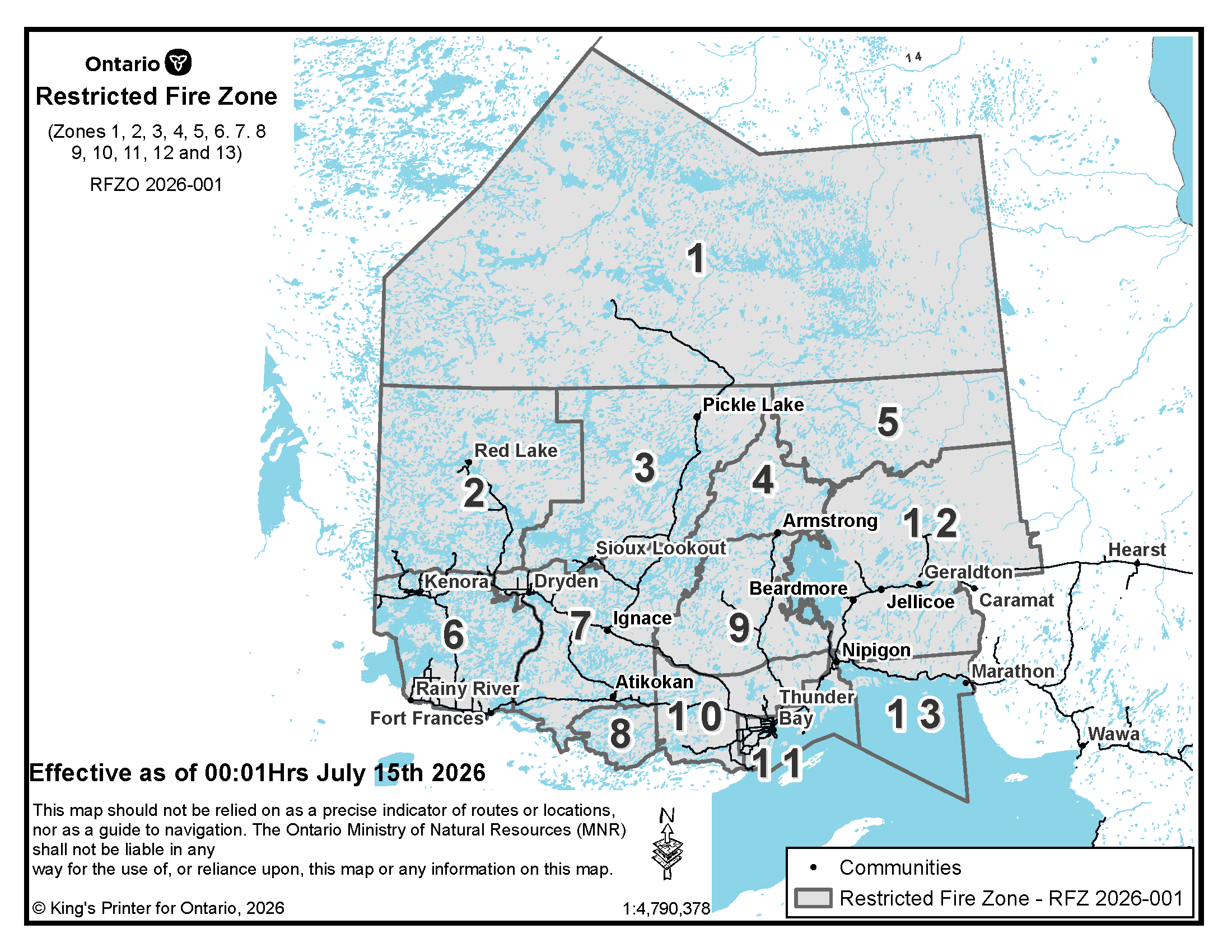
Northwestern Ontario and a small portion of northeastern Ontario remain under a restricted fire zone, which means no open-air burning, including campfires, is allowed.
The forest fire danger rating is low to moderate across most of northwestern Ontario, with pockets of high hazard in the Nipigon, Dryden and Kenora fire management sectors.
According to the province’s interactive highway map, the following roads are closed due to wildfire activity:
The Ontario Provincial Police (OPP) urge people for their safety and the safety of emergency responders to:
Mail delivery has been suspended in the following communities due to wildfire activity:
“Effective July 24, residents and businesses of Aroland (P0T 1B0), Cat Lake (P0V 1J0), Gull Bay (P0T 1P0), Armstrong Station (P0T 1A0) and Collins (P0T 3E0) receive free Mail Forwarding service for up to 12 months. Impacted residents have until Aug. 24 to register for the free service,” Canada Post says.
No new wildfires were confirmed in northeastern Ontario by Sunday evening.
There are 38 active wildfires in the northeast. Of these, one is not under control, one is being held, four are under control, and 32 are being observed.
The forest fire hazard is mostly low to moderate in the northeast, with pockets of high hazard in the Sudbury, North Bay and Haliburton fire management sectors.
There are now more than 2,835 wildfire evacuees from more than a dozen communities across the province, according to an update issued by Ontario’s Minister of Emergency Preparedness and Response, Jill Dunlop, on Friday evening.
They are staying in eight official host communities.
There have been four Ontario Corps partners and 17 Ontario Corps volunteers sent to help. As well, the province says the following equipment/supplies have been provided:
As part of these efforts, Feed Ontario and the Ontario Federation of Indigenous Friendship Centres are shipping and distributing food to evacuees. GlobalMedic has also delivered essential supplies to the evacuation reception centre at the Fort William Gardens Arena in Thunder Bay.
In addition, the Kaministiquia and Upsala fire departments were among some regional fire services to receive wildland fire skids from GlobalMedic.
The City of Thunder Bay has moved from active emergency co-ordination to enhanced monitoring.
“Wildfire conditions across northwestern Ontario remain serious but stable… and no new evacuations are anticipated at this time,” the city said in an update late Wednesday afternoon.
“The city stands ready to assist, should additional support be required.”
How to reduce wildfire risk and the likelihood of property damage in Thunder Bay, Ont.
Residents are encouraged to take steps to reduce wildfire risk around their homes and properties by following FireSmart principles, including:
More information about FireSmart practices is available at www.firesmartcanada.ca.